Our Curriculum Overview
At All Saints Church School we have designed our own creative curriculum which encompasses all our beliefs and intentions for encouraging and developing our young children to be independent learners.
This curriculum follows the National Curriculum which sets out the programmes of study and attainment targets for all subjects at all 4 key stages.
The Bath and Wells Multi Academy Trust has a set of core principles that all Trust schools adhere to and provides a starting point for all our curriculums, allowing us to create a curriculum that is unique to our own school setting.
Our curriculum is underpinned by our strong Christian vision and ethos which threads through all that we do:
Jesus says, “All things are possible if you believe.”
At All Saints we provide a caring and supportive learning environment underpinned with challenge and high expectations which nurtures each child as they achieve their full and unique potential. We are aware that each child has different interests, strengths and needs which will influence the way in which they learn.
Our curriculum aims to:
Ensure that every child in our care fulfils their potential and develops into a well-rounded, polite, caring and responsible member of the community.
Our curriculum INTENT is that all children develop their knowledge and application of skills as learners. Well planned sequences of learning opportunities will enable children to become curious, resilient, problem solving, collaborative and creative learners who develop a desire to learn and achieve to their full potential.
The curriculum IMPLEMENTATION is delivered through a bespoke curriculum which has been written specifically as a tool to develop confident, disciplined and enquiring learners who are able to make informed decisions.
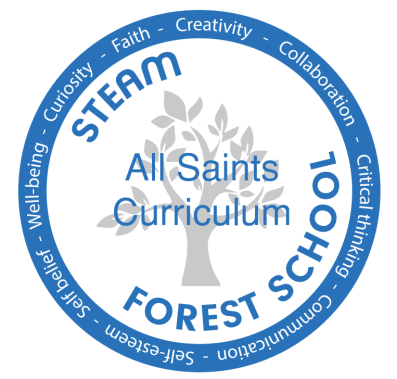
It includes aspects of STEAM (Science, Technology, Engineering, Art and Maths) and outdoor learning threading through all curriculum areas in order to foster a love of learning, igniting wonder, excitement, enjoyment, interest, curiosity, reflection and passion.
Children will be given time and space to explore their social, emotional and moral awareness, nurturing self-motivation and self-esteem using different learning styles.
Children will develop self-motivation and an understanding of the different learning strategies. Children will facilitate considerate and positive relationships between all members of the school community.
The learning opportunities will provide children with the skills and understanding that prepare them to make a positive contribution to society when they leave school.
Our All Saints Curriculum IMPACT will be that children who attend our school will be enthusiastic to learn, confident to take risks and explore, self-motivated as independent learners, have a broad and deep understanding and will have the skills and attitude to pave the way for lifelong learning.
The curriculum will support pupils’ physical development and responsibility for their own health and enable them to be active.
It will promote a positive attitude towards learning.
It ensures equal access to learning, with high expectations for every pupil and appropriate levels of challenge and support.
As a staff, we have created our own curriculum map where knowledge, skills and attitudes are taught, where possible, through linked activities.
Each subject has detailed sequences of learning which are revisited over time and provide a well-planned base for all learning. These sequences can be found on the relevant subject pages. Each of the subject progressions has been coherently designed to build on one another with clear progression and links so that, in subsequent year groups, they will be able to explore concepts deeper, applying their knowledge in different contexts. The curriculum at All Saints Church School builds upon evidence about how pupils learn and retain knowledge in the long term, focusing in particular on research from cognitive science. Our teachers explicitly help their pupils make links between the information they learn, they help them build a detailed, easily recalled web of knowledge from long-term memory.
Jesus says, “All things are possible if you believe.” Mark 9:23