History
We aim to provide a history curriculum that enables pupils to be curious and develop a strong desire to ask questions such as When? How? What impact? and Why? This curiosity promotes a thirst for knowledge and enquiry that extends beyond their time at All Saints.
Through carefully planned activities and experiences, our children learn to carry out historical investigations, think independently, develop curiosity about the past, and refine their skills in analysing and interpreting evidence.
How do we teach history at All Saints?
Our approach to teaching history reflects our vision and is underpinned by high-quality, research-informed practice. We use the CUSP History curriculum to ensure learning is carefully sequenced, builds on prior knowledge and supports long-term understanding.
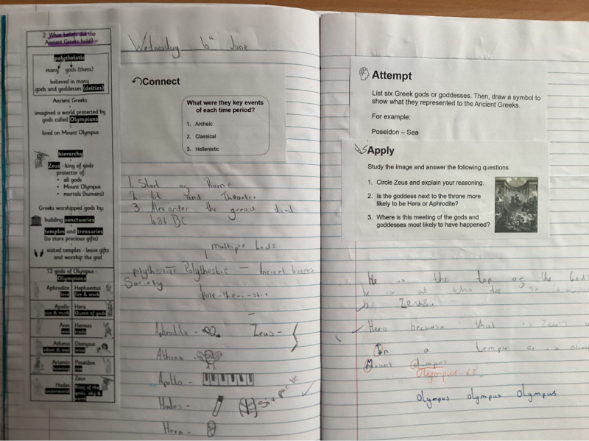
History units structure content into meaningful sequences that support knowledge retention, each including substantive and disciplinary knowledge. Substantive knowledge is the subject knowledge and explicit vocabulary used to learn about the content. Disciplinary knowledge focusses on causation, change and continuity or historical perspective, for example.
We teach subject specific vocabulary explicitly and revisit key terms regularly to deepen understanding.
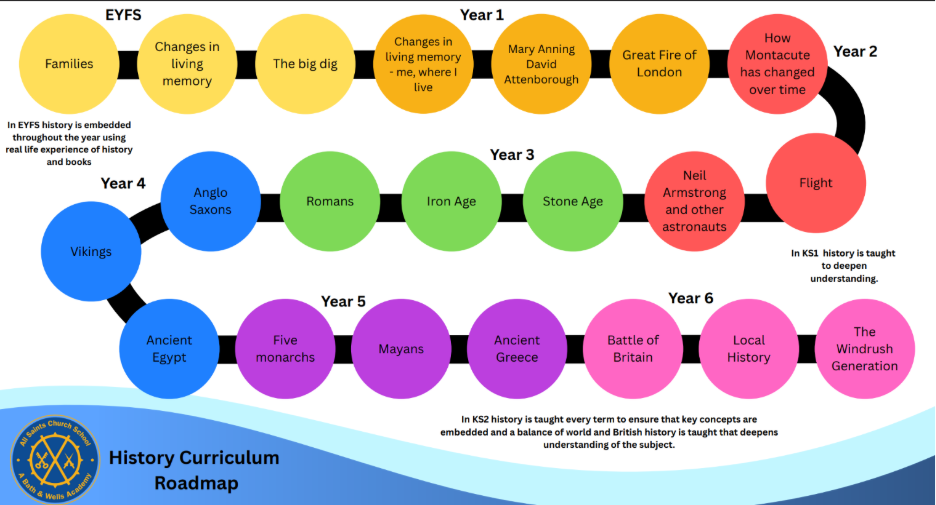
A key principle of CUSP History is that each topic builds on prior learning. For example, in the Early Years Foundation Stage (EYFS), pupils might explore Changes in Living Memory through activities in their local environment, which is later revisited in Year 1 when studying their Changes in Living Memory unit, and again in Year 2 with their How Montacute Has Changed Over Time unit. This connection to existing knowledge helps students process new, potentially abstract concepts more easily, accelerating their learning by integrating what they already know.
Teachers build on pupils’ prior knowledge, break learning into manageable steps and adapt teaching to meet the needs of all learners.
We use questioning, discussion, retrieval practice and knowledge organisers to support long-term memory and understanding.
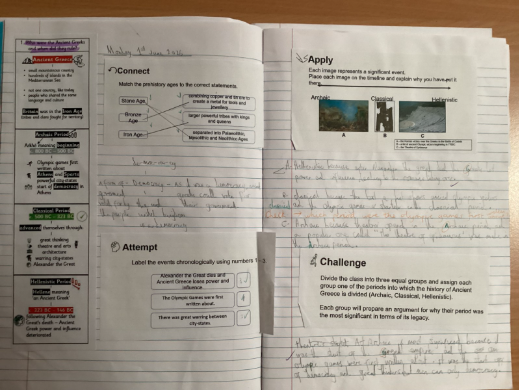
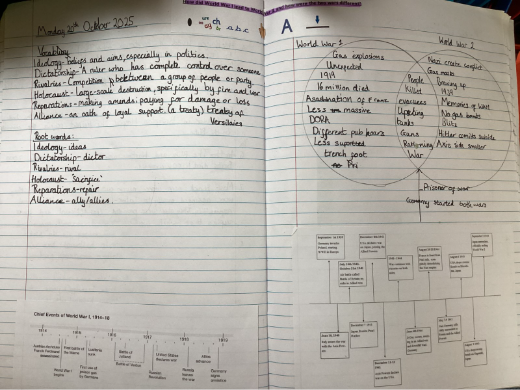
Pupils use a double-page spread approach to organise learning, refer to knowledge notes and structure their thinking clearly.
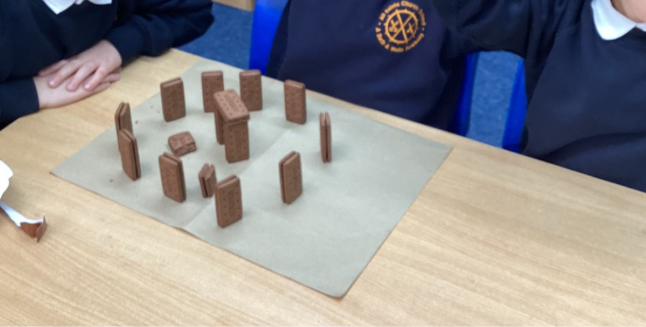
History learning includes practical, experiential experiences that encourage curiosity, investigation and critical thinking, as well as engaging with artefacts and historical texts and images.
EYFS
Young children are naturally curious and passionate about learning. At All Saints, we provide a stimulating EYFS curriculum that nurtures children’s natural curiosity and their ongoing knowledge and understanding of the world around them. Through hands-on, enquiry-based activities, children will experience the joy of learning ‘how’ and ‘why’. We seek to promote this open-mindedness and further develop their enquiring minds, so they eventually become independent learners. We believe in equality of access and aim to unlock pupils’ potential for future life choices.
Our history roadmap shows the themes of history and how they progress and build upon each other as children move through our school.
At All Saints Church School, we have a whole school ethos of being Ready, Respectful and Safe. Our history curriculum enables children to respect both the immediate and wider community and diversity. We encourage our children to be responsible and recognise diversity around them and throughout history.
By providing inspiring learning opportunities, we ensure that our children are motivated, confident, life-long learners who will continue to explore the world around them, way beyond their time at primary school. To help them identify and retain the key information in each unit of work, we provide children with a knowledge organiser. These can be referred to in lessons, and they also act as a tool to support children in retrieving and retaining knowledge for lifelong learning.
EXTRA-CURRICULAR
To enhance our history curriculum, we provide a range of extracurricular experiences and opportunities for our children.
We enhance our history learning with trips and visitors to school at every opportunity. Our locality provides unique opportunities to explore local history with the beautiful National Trust Montacute House across the road. Classes visit the grounds and house regularly and are emersed in local history.

Please note: we are unable to share our knowledge organisers for history due to licencing laws
Useful Websites
South West Heritage Online Activities
Jesus says, “All things are possible if you believe.” Mark 9:23